How to survive solo Rust for 14 days like an apex survivor
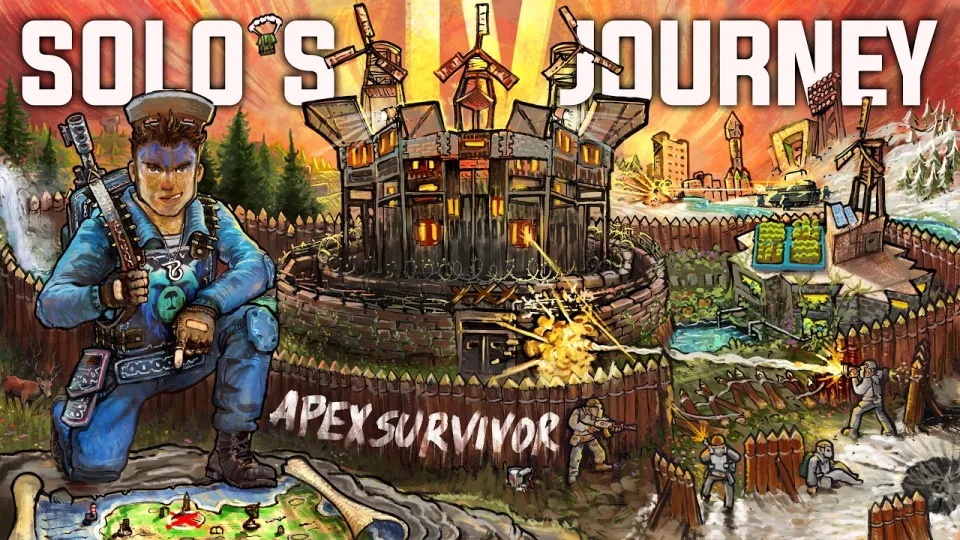
Video: Rust - A Solo's Journey IV: Apex Survivor (Movie)
Need articles like this for your video? They help promote it on YouTube and Google — order them in the Telegram bot @sat_sit_bot. Articles with your video embedded are written and posted by the bot itself — on popular topical sites (no ads). Free trial — 50 articles.
· based on the channel Blooprint
Key takeaways
- Blooprint's Solo's Journey IV covers 14 real days of solo Rust on one wipe, cut into a movie of nearly five hours.
- The run was filmed and edited by Blooprint himself, with over 300 hours of production work behind the final cut.
- A companion tracker at solosjourneytracker.com maps any timestamp in the video to the player's progress at that moment.
- The movie is split into 12 chapters plus an intro and an ending, and the channel marked the project with a 2.5M subscriber milestone.
- Solo Rust means no clan support: every farm run, raid defense and monument trip is done by one player.
Solo Rust survival comes down to three habits: build small and cheap away from main roads, farm in short repeatable loops instead of long greedy runs, and treat every fight as optional unless the loot justifies the risk. Blooprint's 14-day solo run in "A Solo's Journey IV: Apex Survivor" is a full-length demonstration of exactly that discipline, and a companion site at solosjourneytracker.com lets you type in any timestamp and see the player's progress at that point in the challenge.
The movie itself is an outlier for the channel: 14 days of solo play on one wipe, filmed and edited by Blooprint with more than 300 hours of production work, released as a single video close to five hours long and split into 12 chapters plus an intro and an ending. It is not a tutorial, but it works as one if you watch how decisions compound over a long wipe rather than over a single session.
What solo Rust actually demands over a long wipe
Solo Rust is a resource-management game disguised as a shooter, and the clock is the real opponent. On a group server, a clan can absorb a lost fight because someone else is still farming; a solo player loses the base, the kit and the evening in one bad decision. That asymmetry is what makes long solo runs interesting to watch and brutal to play.
The practical consequences are simple. Every trip out of the base should have a defined purpose and a defined exit. Every base should be cheap enough to rebuild in an evening. Every fight should be entered with a plan for what happens if it goes wrong. Blooprint's run is built on those constraints for two full weeks, which is why the pacing reads as survival rather than as a highlight reel.
Base building and farming routes that survive contact
A solo base in Rust should be disposable, boring to raid and close to the resources you actually use. The most common solo mistake is building something impressive early: a big footprint signals loot, invites offline raids and costs more stone than one player can comfortably replace after a bad night.
A workable solo checklist:
- Place the first base within a short run of a reliable farm route, not on a main road or directly next to a monument entrance.
- Keep the core small and honeycombed; a compact triangle or square core with cheap outer layers beats a wide open plan.
- Split storage across at least two rooms so a single breach does not hand over the whole wipe.
- Keep a hidden stash or secondary bunker with a rebuild kit: tools, a weapon, some cloth and a few hundred of each core material.
- Upgrade in this order: doors and core first, then honeycomb, then anything cosmetic.
Farming works the same way. Short loops of ten to fifteen minutes with a known route beat hour-long expeditions, because each loop caps your potential loss. Nodes, barrels and animal spawns along a loop you can run with your eyes closed will outproduce a wandering farmer every time, and a predictable route makes it obvious when someone is following you.
Monuments, oil rig and cargo ship as a solo player
High-tier monuments are the fastest way for a solo to close the gear gap, but they are also where solos die most often. Oil rig and cargo ship hand out top-tier loot, and both attract groups who expect to find a lone player there. The realistic approach is timing and exits rather than raw fighting skill.
Useful habits for monument loot as a solo:
- Go early in the morning or late at night on your server's clock, when group activity drops.
- Scout first: listen for gunfire, watch for bodies and check whether doors are already open.
- Bring exactly what you can afford to lose and nothing you would miss.
- Plan the exit before you enter; know where your boat or vehicle is and which direction is safe.
- Bank the loot immediately. A successful run that ends in a fight on the way home is a failed run.
Cargo ship is often the safer of the two for solos because it moves and because the approach is visible from a distance, while oil rig rewards preparation with crates but punishes hesitation. Either way, the value is not the crate contents, it is the fact that you came back with them.
Raiding, revenge and reading the server
Raiding as a solo is a numbers problem before it is a combat problem. Sulfur, explosives and boom cost time, and time is the resource you have least of when you are also farming, crafting and defending. That means solo raids should target soft, valuable bases: small groups, poorly honeycombed walls, and players who have visibly accumulated loot without upgrading defenses.
Server politics matter as much as explosives. Knowing which clans are fighting each other, who is currently offline, and which neighbors are aggressive changes what is safe to do on any given day. A solo who understands the map's social geography can farm in peace during a clan war and get wiped in five minutes during a quiet week. Revenge raids are satisfying, but they are also the fastest way to convert a stable wipe into a short one, so they should be planned with the same cost-benefit thinking as any other raid.
Common doubts about long solo runs answered
Viewers of long solo movies tend to raise the same practical questions, and they are worth addressing directly. The first is time: a 14-day solo run is not 14 days of continuous play, it is 14 days of a wipe in which the player logs in, makes progress and logs off, which is why the story can span a full wipe without the player living inside the game.
The second is gear fear. Long solo runs work because the player treats kits as consumables; hoarding a good set in a box is the same as not having it. The third is boredom. Solo Rust is quiet for long stretches, and the players who last are the ones who find a rhythm in farming, building and small objectives rather than waiting for something to happen. The fourth is community: solo servers are not empty, and interactions with neighbors, both friendly and hostile, are a large part of what makes a two-week run watchable.
Useful links
- Solo's Journey tracker — enter a timestamp to see progress during the challenge.
- Blooprint Youtooz vinyl figure — limited run, available until October 27, 2026.
- Blooprint mousepads and playmats — available until January 3, 2027.
- Hires Studio — animated intro work for the movie.
- Veys — thumbnail art.
Final thoughts on the apex survivor approach
What makes a 14-day solo run instructive is not any single play; it is the accumulation of small, unglamorous decisions about where to build, when to farm and when to walk away. Blooprint's movie is a rare long-form look at that accumulation, and the companion tracker at solosjourneytracker.com turns it into something you can actually study chapter by chapter. If you want to improve at solo Rust, watch how the base grows, how the loot is stored and how fights are chosen, then copy the habits rather than the highlights. The channel Blooprint is the author of this breakdown and of the original run.
Questions & answers
How long does a 14-day solo Rust run actually take to play?
It is 14 days of a single wipe, not 14 days of continuous play. The player logs in, farms, builds, raids and logs off, so the run spans a full wipe cycle while still leaving room for sleep and real life. The video condenses that into a movie of just under five hours.
Is it realistic to hit oil rig or cargo ship alone without a clan?
Yes, but timing matters more than aim. Going when group activity is low, scouting before committing, bringing only gear you can lose and banking loot immediately turns both monuments into reliable solo income. Treat the exit plan as part of the loot run.
Why do solo players build small bases instead of big ones?
A small, honeycombed core is cheaper to rebuild, gives away less loot per breach and attracts less attention. Splitting storage and keeping a hidden rebuild kit means one raid does not end the wipe, which is the main risk a solo player faces.
What is the tracker website for?
The site at solosjourneytracker.com maps a timestamp from the video to the player's progress at that moment, so you can follow the run in parts or jump to a specific stage. It was built specifically for this solo challenge movie.
Source: Rust - A Solo's Journey IV: Apex Survivor (Movie) · Markdown version